


On September 23rd, Dr. Jeff Polet was hosted by Baylor University in the Honors College reading room as the guest speaker for the Laura Jackson Endowed Lectureship in World Issues. Polet is the Director of the Ford Leadership Forum at the Gerald R. Ford Presidential Foundation and a former professor of political science at Hope College.

The lecture, “Getting What We Deserve,” was a timely reflection on the widely perceived crisis of leadership in America and the broader West. Although the crisis seems to be endemic to our current political landscape and social fabric, Polet explained that “our leadership class is reflecting a much deeper trend in political life.”
“When we think about ‘getting what we deserve,’” he said, “we might well ask: Who’s this we? What are we getting? And why do we deserve it?”
Polet began his remarks by mildly challenging the all-too-common assumption that democratic governments are a fountain stream of blessings, devoid of any major imperfections. “Among the advantages of monarchy,” he said, “not having to live through quadrennial elections and strenuous campaigns ranks high in the list.” This may be especially relevant during this election cycle, when a fateful many undecided voters seem weary and disappointed with the binary choices.
Good leaders will be persons of high character and sound judgement.
Jeff Polet
In this sense, “monarchy also gets subjects off the hook,” as they cannot be blamed — at least not directly — for the cruelty or incompetency of their sovereign. Of course, Polet conceded, monarchy could easily bring about reckless and incontinent rulers, “but it’s not as though democracy has such a great record these days.” Moreover, the rhetoric of this being “the most important election of our lifetime” has become a tiring repetition every four years, fomenting skepticism over the authenticity of each election’s actual importance.
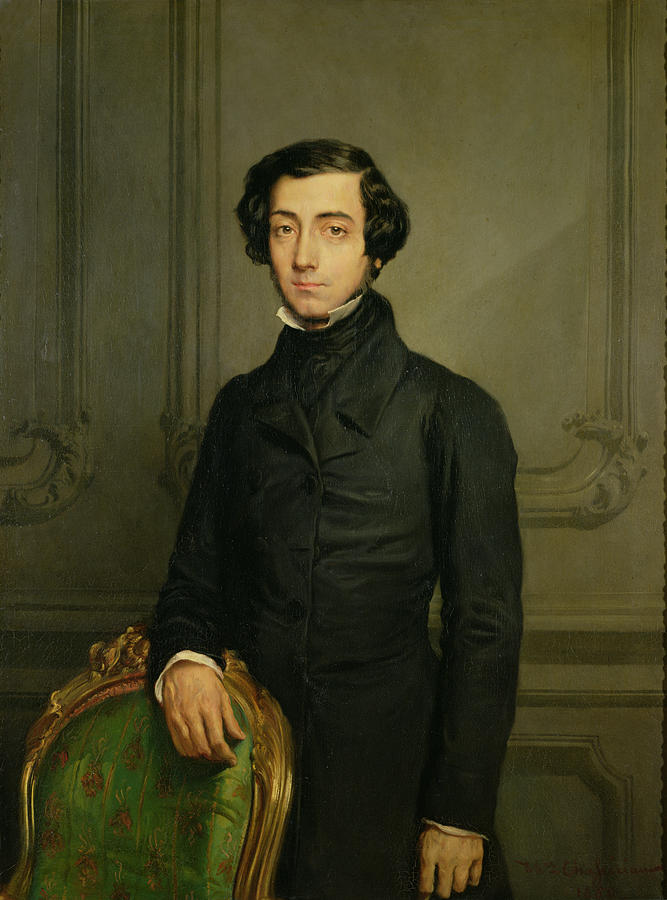
Yet, Polet clarified, too narrow a focus on politics may blur the depth of our problems. He cited Tocqueville to explain the relationship between the health of all civic associations, from one’s trust in one’s neighbors to collective trust in institutions, and how the crisis is not merely political, but also inherently social. The breakdown of associations has arguably led to a major disconnect between the “few” and the “many,” as Aristotle would have described it. In our contemporary parlance, the divide is described as that between “ordinary people” and the “elites,” but the concept is essentially the same.
“Today,” Polet said, “it is a costly fact in the United States that the most outstanding men are rarely called to public office.” The once-esteemed class “of American statesmen has become significantly smaller” than what past generations had to offer. Why is this? Polet seemed to argue that it has something to do with the aforementioned societal disconnect.
The crisis is not merely political, but also inherently social.
Addressing the particularities of the crisis in the American context, he cited some of Madison’s insights from The Federalist. He explained how “the essence of politics involves the resolution of conflict,” given that conflict is embedded in “the human condition.” Many elements of the Madisonian republicanism we find in the pages of The Federalist are directed at such ends. Polet pointed out that “Our Constitution, for example, is a compromise document,” arguably designed “for a contentious people.” Furthermore, “one of the reasons why it has worked for as long as it has is [that] it tries to channel this contentiousness into energetic action; and that end is largely accomplished through executive power.” This is why “we tend to equate the health of the country with the quality of our most visible leaders, and in this day and age that means the presidency.”

This was reminiscent of Joseph de Maistre’s insight that “properly speaking, all governments are monarchies which differ only in whether the monarch is for life or for a term of years, hereditary or elective, individual or corporate.” In his famous case for a mixed regime, St. Thomas Aquinas also maintains that good governments require a monarchical element, which we now refer to as “executive power.” Thus, if a given society were experiencing a crisis of leadership, it would eventually be reflected at the executive level.
Polet also emphasized how, in contrast with Aristotle and the Angelic Doctor, “Hamilton and Madison provide a sober,” even pessimistic “view of human nature.” But, they both “acknowledge that we need good leaders.” Polet’s presentation of the Founding, therefore, seemed to follow the interpretation that conceives the American experiment as an effort to reconcile Enlightenment principles with a characteristically ancient pursuit of the common good. He maintained that “republican systems seem to assume the following: good leaders will be persons of high character and sound judgement, and as such we trust them with the enormous powers invested in them.”
Republicanism for Polet, then, depends on there being good leaders, and that they be willing to partake in public life. As for what makes a good leader, Polet cited Madison and Hamilton to contend that it must be one who shares a certain bond with the people he is tasked to represent. Madison’s words could not be more relevant today: “But if those ties which bind a representative to his constituents are ever weekend, then the very possibility of republican government becomes unthinkable.”
“Our current crisis of leadership results directly from the loosening of those bonds,” said Polet, “not only in our political institutions but in all institutions. We increasingly feel distant from those in positions of authority.” Indeed, these are the seeds of the populism we have seen emerge over the last two decades, stemming from the perception that our ruling class is “too often operating from a set of interests contrary to the good as we understand it, or to the wellbeing of the institutions they run.”
Polet acknowledged recent populist trends as being legitimate, insofar as they are the justified reaction to the loosening of bonds between leaders and ordinary people. Yet, in terms of the broader crisis, he identified three sources from which it arises:
- The loosening of bonds between leaders and their respective constituents, exacerbated by contempt. Earning back the trust of ordinary people will be impossible without sharing in their fate and their misfortunes.
- The rise of a centralized administrative state, whereby average citizens experience themselves as being at the mercy of anonymous powers — these powers being at the hands of elites who then use them to reward friends and punish enemies.
- The desire for material comfort, and the role of money and securing it.
The latter two are just as consequential as the first, Polet argued. And, to some degree, they are all interrelated. The expansion of the administrative state is largely responsible for the loosening of bonds, and the desire for material comfort among the masses fuels the existence of such a state. Quoting Tocqueville, Polet expounded on how materialism leads to “a soft despotism that could turn democratic peoples into timid and industrious sheep, with government as their shepherd.” Lacking a common pursuit of the good, a common telos, the quest to attain material wealth has come in its place, reaping the venomous crops of greed, isolation, and constant competition among those who would otherwise relate to one another as neighbors and kin.
Our current crisis of leadership results directly from the loosening of those bonds, not only in our political institutions but in all institutions.
Jeff Polet
As a remedy for the crisis caused by these interrelated problems, Polet concluded by proposing restraint — not merely for the governing, but also for the governed. Restraint, he contended, is opposed to both the “imperial impulse” of the administrative state and the acquisitional impulse of the masses. Lack of restraint, on the other hand, is the reason “our Constitution no longer operates from the principle of limited government,” and is now a “fluid adaptation to changing mores.” Our ills could thus be summarized as “unrestrained appetite, either personally or politically.”
But how shall we reintroduce restraint into our social and political life? Polet alluded to some alternatives, including a process of “decentralization” in the political sphere, while fostering “lives of mutual dependence” in the social sphere. Amidst the sobriety of the diagnosis, there was an air of hope in the concluding remarks. If we begin to work toward these aims, Polet implied, we may yet be able to save our nation from the calamities that have befallen other, once-great civilizations. Whatever happens, one thing is clear: we have deserved it. In the words of de Maistre, “every country has the government it deserves.”


